
| |||

|

|

|

|

|

|

|

|

|
Camp Chase Prisoner of War Camp
2900 Sullivant Avenue, Columbus, Ohio

|
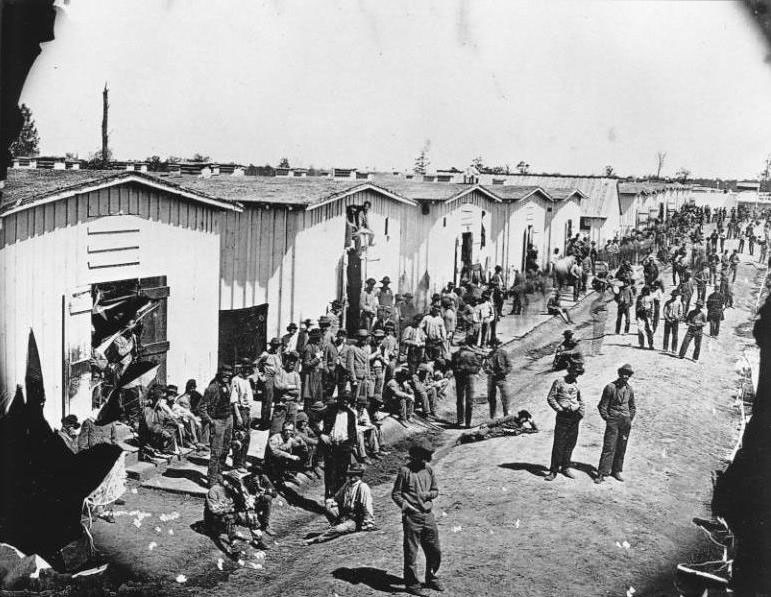
Early inmates at the Camp Chase prison camp were chiefly political and military prisoners, from Kentucky and western Virginia. However, Union victories at Fort Donalson, Tennessee on February 16, 1862 and at Mississippi River Island No. 10 on April 8, 1862 brought a new influx of prisoners. All of the officers taken at these battles, except general and field officers who were sent to Fort Warren in Boston Harbor,were transferred to the Camp Chase prison. When the Confederate Stockade on Johnson’s Island in Lake Erie was established most of the officers at Camp Chase were sent there. Following this transfer, men from the ranks, the privates, corprals and sergeants, made up the bulk of the Confederate soldiers confined at Camp Chase. The high tide of the prison population at Camp Chase was reached in 1863 when some 8,000 men were confined there. During the winter of 1863-1864 a smallpox epidemic caused many deaths. In November 1864 there was an exchange of 10,000 sick and wounded prisoners between the North and South. Prior to the establishment of a cemetery at Camp Chase prison, the Confederate soldiers who died there were interred in the City Cemetery of Columbus, Ohio. After the cemetery was established at Camp Chase late in 1863 their remains were re-interred in the prison cemetery.
Newspaper article from the "Columbus Crisis"
Conditions at Camp Chase, December 24, 1862
~~~~~~~~~~~~~~~~~~~~~~~~~~~~~~~~~~~~~~~~~~~~~~~~~~~~~~~~~
"We speak wholly of the political prison, of the State, as we know nothing whatever of what occurs in the prison where "rebels taken in arms" are kept—that is, "the prisoner of war."
It must not be forgotten that there have been from six to seven hundred political prisoners at Camp Chase at a time; and although several hundred have been lately discharged without trial, there are yet there some four hundred—one or two hundred of these have arrived there within a few days past from Kentucky and Western Virginia. These men were taken from their homes, some from their beds at night, some from their homes in daytime, and a great many of them are picked up in their fields at work, and never suffered to see their families before being spirited off to Ohio and incarcerated in the celebrated Bastile, which will soon be as famous as Olmutz itself.
Our Ohioans are put into the same prison with these men from other States, and from them we have learned some facts which the people of Ohio ought to know. Many of these men have been kept in this prison for over one year, a great many for five, six, seven and eight months, without even seeing outside, or being allowed to communicate personally with any one, not even wife, child, father, mother, or stranger.
They are furnished with nothing but a single blanket, even these cold nights, unless they are able to purchase additional comforts with the money they may be able to command. Many are poor men, and unable to purchase; they were not permitted to bring along a change of clothing, and many had on when seized nothing but summer wear, and that has become filthy, worn out, and scarcely hangs upon their backs. They have no bedding, and are therefore compelled to sleep on bare boards. They have not enough wood furnished to keep fires up all night, and hence the suffering is intensified by the cold weather. If they attempt, after night, to walk out in the yard to take off the chills of the dreary night, they are instantly threatened to be shot by the guards, as ordered by those in command.
Dr. Allen, of Columbia county, Ohio, said he laid on a bare board until his hips were black and blue. The wood furnished them is four feet long, and they are compelled, each mess, to chop it up for themselves. Recollect, always that these are political prisoners, against whom no one appears as accuser, and no trial is permitted. The prison has become filthy—awfully so—and the rats are in droves. If the prisoners attempt to kill one of these rats, they are forbidden, and threatened with being shot instantly. Recollect, as we have said before, these are political prisoners, against whom some malicious negro-worshipper has created a suspicion of disloyalty, but whose name is kept secret, and hence there can be no trial.
The prison is perfectly alive with lice, and no chance is given to escape the living vermin. A dead man, one of the prisoners, was the other day carried out to the dead-yard, laid there over night, and when visited in the morning by other prisoners, who heard there was a dead man there, they found the hair on his head stiff with lice and nits—the lice creeping into his eyes in great numbers, and, as he lay, they were thick, crawling in and out of his open mouth.
Not long since two of the prisoners got into a scuffle in trying their strength, and finally into a fight, as was supposed, and several other persons rushed to part them, when the guards from the lookout above fired on them, killing an old man by the name of Jones, from Western Virginia, and a ball grazing the skull of another; he fell, and it was supposed at first, he was killed also; another of the balls passed through a board at the head of a sick man in the hospital, and only escaped him by a few inches. The two men in the scuffle were not hurt. We might go further, but God knows this is enough for once. It is enough to make one’s blood run cold to think of it.
Now, if any one doubts this—if the authorities at camp or at the State House doubt it—if the Legislature, when it meets, will raise a committee, we promise to name the witnesses who, if sent for, will, under oath, prove all this, and as much more, some of which is too indecent to print in a newspaper for the public eye."

|

|
|

|

|

|

|

|

|

|

|

|

|

|

|

|

|

|

|

|
|
Find-a-Grave: Camp Chase Cemetery | ||||||
|
1864 Camp Chase Grave Robbery During the night of November 24, 1864, a gruesome crime took place in the Camp Chase Cemetery. Col. W. P. RICHARDSON, Colonel Twenty-fifth Ohio Volunteer Infantry, Commanding Post , reported on November 26, 1864, that "On the night of the 24th instant the bodies of six deceased prisoners were stolen from the grave-yard attached to camp where prisoners only are buried. I arrested the perpetrators of this outrage and referred the matter to General Hooker and was by him directed to turn the prisoners and papers over to the prosecuting attorney of this county, which I have done. Respectfully referred to the Commissary-General of Prisoners." After some further investigation I was able to establish a list of the victims. The official records indicate that the bodies were "removed" from the cemetery with no remark as to the circumstances. None of the bodies were recovered.
Grave # 507 Hensley, A. S. Co. B, 45th VA CAV, d. Nov. 23, 1864. Removed! Blank's name does not appear in the CWC database and Blund's name does not show on Knauss' list...it makes me consider that "Blank" wasn't a name at all but simply stood for "blank" as in not having the man's last name available when Knauss' list was compiled. Also, both men's first name start with the letter "H". The only discrepancy is the difference in units. Is H. Blank a conglomerate of Hiram Blund and Andrew Jackson Hicks who served in the 34th VA Cav.? It appears that Andrew Jackson Hicks may have been buried in the empty grave of his predecessor whose grave was robbed and that in the aftermath the records may have been mixed up. At this point though, this is mere speculation on my part. Any further information about the men in question, such as verification of service, place of burial [if applicable], or any other pertinent information would be greatly appreciated. Area newspaper articles perhaps reporting the crime and/or photographs of the markers would be wonderful as well . Please contact me if you can assist in any way.
McCormick, Robert W. "About Six Acres of Land: Camp Chase, Civil War Prison." September-October 1994: 34-43.
|


